Shenzhen · Subway

Useful Phrases

Current language and Chinese are shown together for quick communication.

Fixed #10

Take me to the nearest subway entrance.

请带我去最近的地铁入口。

Fixed #20

Can I scan a QR code to enter the station at this stop?

这一站可以刷二维码进站吗?

Fixed #30

I’m going to this address—please let me off here.

我要去这个地址,请在这里下车。

Here are two things to know first: Shenzhen Metro covers border checkpoints, commercial districts, tourist attractions, and transportation hubs—making it typically the most convenient and cost-effective way for foreign visitors to get around Shenzhen.

  • The system is busiest on weekdays from 7:30–9:30 AM and 5:30–8:00 PM; transfers and entry through ticket gates take longer on popular lines during these times.
  • If you’re visiting Shenzhen for the first time, we recommend traveling between 10:00 AM and 5:00 PM—it’s much easier to navigate and transfer.
Guide Steps
  1. 1. View the route map first, then check transfers
  2. 2. How to Estimate Ticket Prices First
  3. 3. Choose Your Ride Based on Your Situation
  4. 4. When Is a One-Day Pass, Three-Day Pass, or Shenzhen Tong Card Right for You?
  5. 5. How to Enter and Exit the Station by Different Modes of Transport
  6. 6. If purchasing a one-way ticket, first read the instructions on the machine, then make your payment.
1

View the route map first, then check transfers

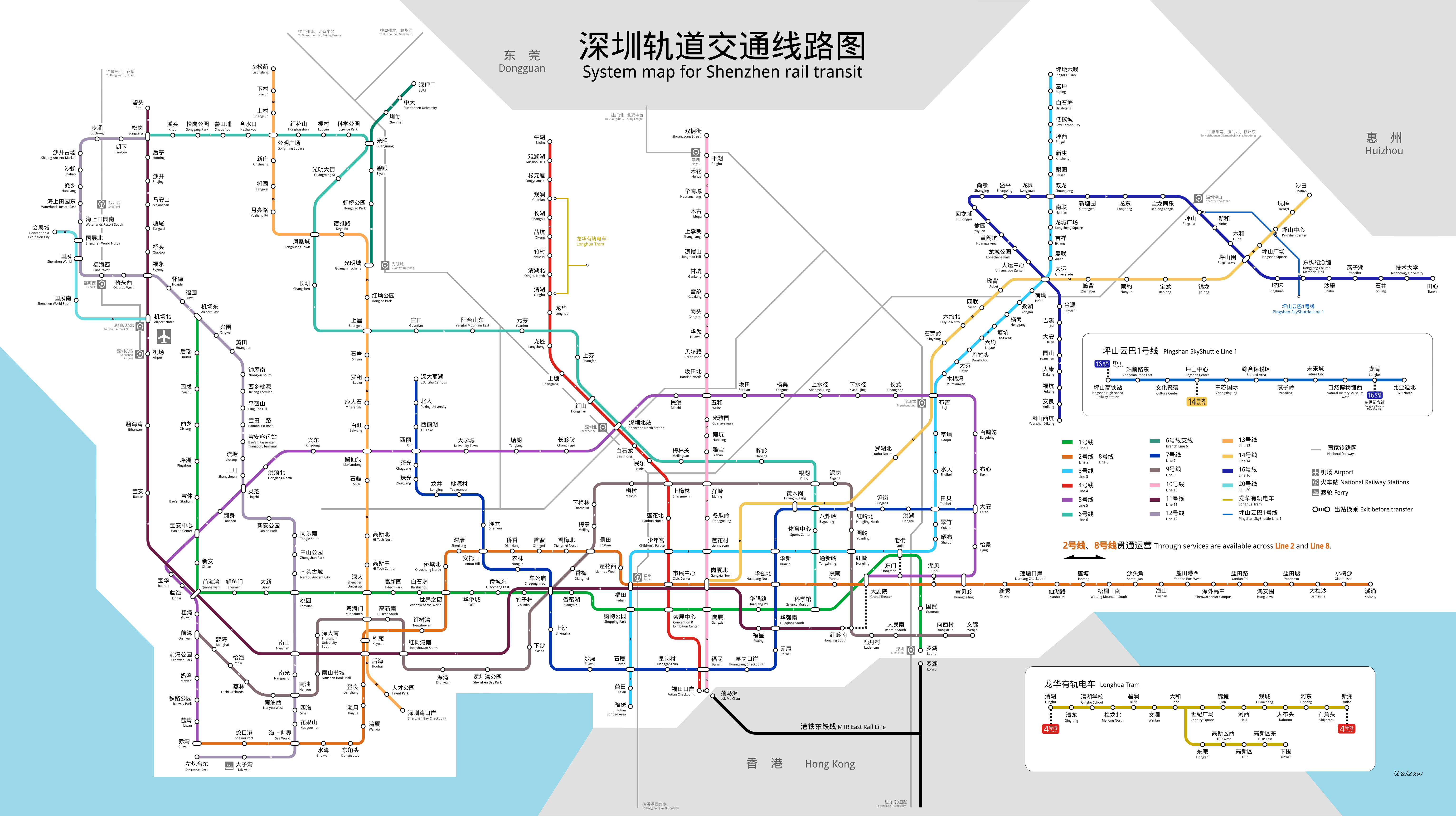
Shenzhen Metro

Map source: Wahsaw / Wikimedia Commons. License: CC BY-SA 4.0.

First, use the Shenzhen Metro map above to confirm your departure station, destination station, line color, and likely transfer stations.

If you want to confirm how to travel between two stations, keep going to the planner below. After entering “From” and “To”, you can review the recommended line, direction, transfer steps, and an approximate travel time based on distance.

For first-time visitors to Shenzhen, a practical approach is: use the map to build your direction first, then use the planner below to confirm where to transfer.

Loading metro network...
2

How to Estimate Ticket Prices First

Shenzhen Metro fares are calculated based on distance traveled. The base fare is typically ¥2 (for trips up to 4 km), with incremental increases for longer distances.

  • Short trips within the city center usually cost around ¥2–¥9
  • Longer, cross-district routes typically cost around ¥6–¥14
  • The final fare is displayed on ticket vending machines, route planning pages, or QR code payment screens after you select your route

There’s no need to memorize fares in advance. Once you’ve selected your destination, the system will display the exact amount you need to pay.

3

Choose Your Ride Based on Your Situation

Recommended order (for most international visitors):

  1. Supported international contactless card / mobile wallet: This is now the easiest option. Since June 30, 2026, Shenzhen Metro has been trialling tap-to-ride across its network for Visa, Mastercard, American Express, and JCB cards. If your card supports contactless payment, tap the physical card—or the same card in a supported mobile wallet—at a gate displaying the acceptance mark. No app download is required. Use the same physical card, or the same card on the same phone, to enter and exit.
  2. Alipay / WeChat metro QR code: If you already have a metro code enabled, you can scan it to enter and exit. See our Alipay Metro Guide and WeChat Metro Guide.
  3. Single-journey ticket from a ticket machine: A reliable choice if you do not have a supported card, only expect to ride once or twice, or do not want to set up an app.
  4. One-day / three-day pass: Useful for frequent metro travel over one to three days, although physical passes are not sold at every station.
  5. Shenzhen Tong transport card: Better for stays longer than three days, especially if you will use both the metro and buses frequently.

For a short visit, tap a supported international card first. If you do not have one, use an already activated metro QR code. If neither is available, a single-journey ticket is the most dependable fallback.

4

When Is a One-Day Pass, Three-Day Pass, or Shenzhen Tong Card Right for You?

One-Day Pass / Three-Day Pass: Ideal for visitors who plan to use the metro frequently within 1–3 days.

Type Price Validity Description
One-Day Pass ¥25 Unlimited rides within 24 hours from first entry Suitable for high-frequency travel on a single day
Three-Day Pass ¥75 Unlimited rides within 72 hours from first entry Suitable for intensive travel over several consecutive days

There are two ways to purchase: Digital passes can be bought via the Shenzhen Metro app or the “Shenzhen Metro” mini-program on WeChat; simply scan the generated QR code to enter. Physical passes are typically available only at customer service centers in larger stations—not all stations sell them.

Shenzhen Tong Transport Card: Better suited for visitors staying longer than three days who will frequently use both the metro and buses.

  • A deposit of ¥30 is usually required and fully refundable upon card return.
  • The minimum initial top-up is typically ¥50; subsequent top-ups are generally in whole-number amounts.
  • Card issuance locations include: customer service centers at metro stations, 7-Eleven / FamilyMart convenience stores, and bank branches displaying the “Shenzhen Tong” logo.
  • Foreign visitors can usually apply with their passport—subject to on-site requirements.
5

How to Enter and Exit the Station by Different Modes of Transport

  • International contactless card / mobile wallet: At a gate displaying the Visa, Mastercard, American Express, or JCB acceptance mark, tap your contactless physical card or phone on the reader. Use the same physical card, or the same card on the same phone, to enter and exit. Do not enter with the physical card and try to exit with the phone.
  • Alipay / WeChat metro QR code: Scan the QR code when entering and exiting. Open the code before reaching the gate so you do not have to switch networks or payment screens at the last moment.
  • Single-journey ticket: Tap the round token on the gate reader when entering, then insert it into the collection slot when exiting; it will not be returned.
  • Shenzhen Tong card: Tap the card on the gate reader when entering and exiting, and the fare will be deducted automatically.
  • One-day / three-day pass: A virtual pass is normally used by QR code; for a physical pass, follow the instructions on the ticket or from the station service center.

If you are traveling as a group, remember the one-passenger-per-card-or-code rule: international bank cards and mobile wallets, metro QR codes, Shenzhen Tong cards, and one-day / three-day passes each admit one passenger only for one entry and one exit. One bank card, phone, QR code, or transit card cannot be tapped repeatedly to let several people through. Each traveler needs their own card or mobile wallet, QR code, transit card, or single-journey ticket.

If the gate does not open, your bank card or QR code is rejected, or a ticket/card is retained, go to the station service center first.

6

If purchasing a one-way ticket, first read the instructions on the machine, then make your payment.

Who it’s for: First-time visitors to Shenzhen, travelers planning to take the metro only 1–2 times, or those who prefer not to link any app at this time.

You’ll encounter two types of ticket vending machines: Older models accept cash only; newer ones display “QR Code Payment” on-screen and feature a dedicated scanning area nearby.

  1. If needed, switch to the English interface first.
  2. Select your destination station and the number of tickets required—the fare will be displayed automatically.
  3. Before payment, check the instructions printed on the machine body or shown on-screen: Accepted banknote and coin denominations vary by machine and are not standardized across the network.
  4. On upgraded machines, you may choose Alipay or WeChat Pay via QR code scanning.
  5. Collect your round, single-journey ticket; tap it against the sensor zone to enter the station, and insert it into the collection slot when exiting.

If your banknote is rejected, change is incorrect, or the gate fails to open, head directly to the station’s “Customer Service Center” for the fastest assistance.

Here are a few common pitfalls to watch out for:

  • Peak hours and holidays: Trains and stations become significantly more crowded. If you are on a tight schedule, allow an extra 15–30 minutes.
  • International card tap-to-ride: Use a gate displaying the Visa, Mastercard, American Express, or JCB acceptance mark, and use the same physical card—or the same card on the same phone—to enter and exit. If the card is rejected, do not keep trying random gates; ask at the service center.
  • One-day / three-day passes: Useful for frequent travel within a short period, but physical passes are not sold at every station. They are usually available from service centers at larger stations, while virtual passes can be activated in the Shenzhen Metro app or the “Shenzhen Metro” WeChat mini-program.
  • Shenzhen Tong: Better for stays longer than three days with frequent bus use. For a short stay, tapping a supported international card is normally easiest; otherwise, use a metro QR code or single-journey ticket.
  • Route confusion, failed ticket purchases, or gate problems: Go straight to a station service center instead of waiting at the gate.